קובץ:Tautochrone curve.gif
קפיצה לניווט
קפיצה לחיפוש
אין גרסה ברזולוציה גבוהה יותר.
Tautochrone_curve.gif (300 × 200 פיקסלים, גודל הקובץ: 102 ק"ב, סוג MIME: image/gif, בלולאה, 80 תמונות, 3.2 שניות)
תקציר
| תיאור |
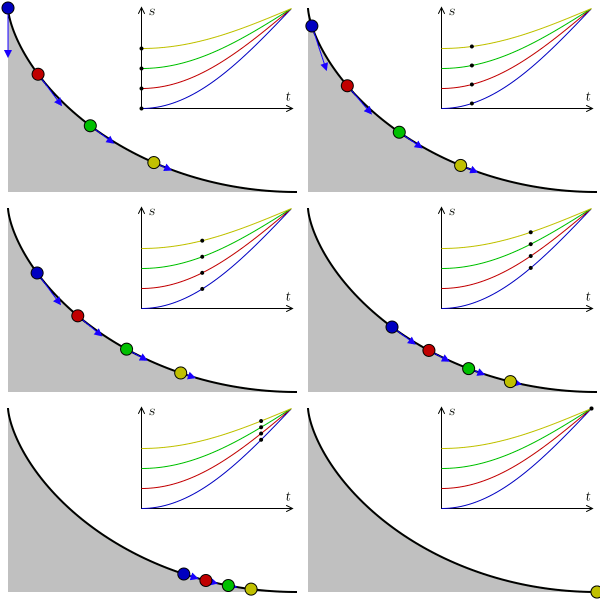
A tautochrone curve is the curve for which the time taken by an object sliding without friction in uniform gravity to its lowest point is independent of its starting point. Here, four points at different positions reach the bottom at the same time. In the graphic, s represents arc length, t represents time, and the blue arrows represent acceleration along the trajectory. As the points reach the horizontal, the velocity becomes constant, the arc length being linear to time. |
| תאריך יצירה | 9 במאי 2007; new version אוגוסט 2009 |
| מקור | נוצר על־ידי מעלה היצירה |
| יוצר |
Claudio Rocchini |
| GIFהתפתחות | |
| קוד מקור | Python code#!/usr/bin/python
# -*- coding: utf8 -*-
'''
animation of balls on a tautochrone curve
'''
import os
import numpy as np
import matplotlib.pyplot as plt
import matplotlib.patches as patches
from matplotlib import animation
from math import *
# settings
fname = 'Tautochrone curve'
width, height = 300, 200
nframes = 80
fps=25
balls = [
{'a':1.0, 'color':'#0000c0'},
{'a':0.8, 'color':'#c00000'},
{'a':0.6, 'color':'#00c000'},
{'a':0.4, 'color':'#c0c000'}]
def curve(phi):
x = phi + sin(phi)
y = 1.0 - cos(phi)
return np.array([x, y])
def animate(nframe, empty=False):
t = nframe / float(nframes - 1.)
# prepare a clean and image-filling canvas for each frame
fig = plt.gcf()
fig.clf()
ax_canvas = plt.gca()
ax_canvas.set_position((0, 0, 1, 1))
ax_canvas.set_xlim(0, width)
ax_canvas.set_ylim(0, height)
ax_canvas.axis('off')
# draw the ramp
x0, y0 = 293, 8
h = 182
npoints = 200
points = []
for i in range(npoints):
phi = i / (npoints - 1.0) * pi - pi
x, y = h/2. * curve(phi) + np.array([x0, y0])
points.append([x, y])
rampline = patches.Polygon(points, closed=False, facecolor='none',
edgecolor='black', linewidth=1.5, capstyle='butt')
points += [[x0-h*pi/2, y0], [x0-h*pi/2, y0+h]]
ramp = patches.Polygon(points, closed=True, facecolor='#c0c0c0', edgecolor='none')
# plot axes
plotw = 0.5
ax_plot = fig.add_axes((0.47, 0.46, plotw, plotw*2/pi*width/height))
ax_plot.set_xlim(0, 1)
ax_plot.set_ylim(0, 1)
for b in balls:
time_array = np.linspace(0, 1, 201)
phi_pendulum_array = (1 - b['a'] * np.cos(time_array*pi/2))
ax_plot.plot(time_array, phi_pendulum_array, '-', color=b['color'], lw=.8)
ax_plot.set_xticks([])
ax_plot.set_yticks([])
ax_plot.set_xlabel('t')
ax_plot.set_ylabel('s')
ax_canvas.add_patch(ramp)
ax_canvas.add_patch(rampline)
for b in balls:
# draw the balls
phi_pendulum = b['a'] * -cos(t * pi/2)
phi_wheel = 2 * asin(phi_pendulum)
phi_wheel = -abs(phi_wheel)
x, y = h/2. * curve(phi_wheel) + np.array([x0, y0])
ax_canvas.add_patch(patches.Circle((x, y), radius=6., zorder=3,
facecolor=b['color'], edgecolor='black'))
ax_plot.plot([t], [1 + phi_pendulum], '.', ms=6., mec='none', mfc='black')
v = h/2. * np.array([1 + cos(phi_wheel), sin(phi_wheel)])
vnorm = v / hypot(v[0], v[1])
# in the harmonic motion, acceleration is proportional to -position
acc_along_line = 38. * -phi_pendulum * vnorm
ax_canvas.arrow(x, y, acc_along_line[0], acc_along_line[1],
head_width=6, head_length=6, fc='#1b00ff', ec='#1b00ff')
fig = plt.figure(figsize=(width/100., height/100.))
print 'saving', fname + '.gif'
#anim = animation.FuncAnimation(fig, animate, frames=nframes)
#anim.save(fname + '.gif', writer='imagemagick', fps=fps)
frames = []
for nframe in range(nframes):
frame = fname + '_{:02}.png'.format(nframe)
animation.FuncAnimation(fig, lambda n: animate(nframe), frames=1).save(
frame, writer='imagemagick')
frames.append(frame)
# assemble animation using imagemagick, this avoids dithering and huge filesize
os.system('convert -delay {} +dither +remap -layers Optimize {} "{}"'.format(
100//fps, ' '.join(['"' + f + '"' for f in frames]), fname + '.gif'))
for frame in frames:
if os.path.exists(frame):
os.remove(frame)
|


רישיון
אני, בעל זכויות היוצרים על היצירה הזאת, מפרסם אותה בזאת תחת הרישיונות הבאים:

|
מוענקת בכך הרשות להעתיק, להפיץ או לשנות את המסמך הזה, לפי תנאי הרישיון לשימוש חופשי במסמכים של גנו, גרסה 1.2 או כל גרסה מאוחרת יותר שתפורסם על־ידי המוסד לתוכנה חופשית; ללא פרקים קבועים, ללא טקסט עטיפה קדמית וללא טקסט עטיפה אחורית. עותק של הרישיון כלול בפרק שכותרתו הרישיון לשימוש חופשי במסמכים של גנו. |
  
|
הקובץ הזה מתפרסם לפי תנאי רישיון קריאייטיב קומונז ייחוס-שיתוף זהה 3.0 לא מותאם. | |
| ||
| תבנית רישוי זו הוספה לקובץ כחלק מעדכון רישיון GFDL. |
הקובץ הזה מתפרסם לפי תנאי רישיון קריאייטיב קומונז ייחוס 2.5 כללי.
- יש לך חופש:
- לשתף – להעתיק, להפיץ ולהעביר את העבודה
- לערבב בין עבודות – להתאים את העבודה
- תחת התנאים הבאים:
- ייחוס – יש לתת ייחוס הולם, לתת קישור לרישיון, ולציין אם נעשו שינויים. אפשר לעשות את זה בכל צורה סבירה, אבל לא בשום צורה שמשתמע ממנה שמעניק הרישיון תומך בך או בשימוש שלך.
אפשר לבחור את הרישיון שמתאים לך.
היסטוריית הקובץ
ניתן ללחוץ על תאריך/שעה כדי לראות את הקובץ כפי שנראה באותו זמן.
| תאריך/שעה | תמונה ממוזערת | ממדים | משתמש | הערה | |
|---|---|---|---|---|---|
| נוכחית | 14:15, 1 באוגוסט 2009 | | 200 × 300 (102 ק"ב) | wikimediacommons>Geek3 | new physically correct version |
שימוש בקובץ
הדף הבא משתמש בקובץ הזה:
